


Please Leave Us A Message
Privacy statement: Your privacy is very important to Us. Our company promises not to disclose your personal information to any external company with out your explicit permission.
 Yangzhou Zhenyue Brush Machinery Co.,Ltd.
Start here: "holes per minute" means tufts per minute, not brushes per minute. Each hole takes one tuft, so an 800 holes/min machine plants 800 tufts per minute. A standard adult brush carries about 40 tufts — ISO 11609's reference uses 38 — so it finishes roughly 20 brushes per minute, not 800. Vendors quoting "brushes per hour" without tufts per brush quote a different product than the datasheet shows.
The core toothbrush tufting machine throughput brushes per day calculation is simple:
Here is the toothbrush tufting machine speed 420 vs 750 holes per minute compared data at mid-range speed, 40 tufts per brush, one 8-hour shift:
| Speed tier | Representative machines (2026) | Typical price band | Brushes per 8h shift | Monthly output (2 shifts, 26 days) |
| 420-520 holes/min | BOBO-class entry 4-axis, semi-auto CNC | $15,000-17,500 | ~4,100 | ~210,000 |
| 750-800 holes/min | Kaiyue GS401, Kaydo 4-axis servo | $17,500-25,000 | ~6,700 | ~350,000 |
| 850-900 holes/min | YX 410, Haixing HS20-14, Chuangyan 820-hole | $24,000-30,000 | ~7,600 | ~395,000 |
| 1000+ holes/min | Chuangyan 2025 high-speed, Zhenyue ZY series (800-1000 cycles/min) | $30,000-32,000 | ~8,700 | ~450,000 |
Three points matter more than the raw numbers:
✅ The jump from 420 to 750 roughly doubles output for $3,000-7,000 more at factory-direct wholesale pricing — the best value step in the range, and where most first-time buyers land.
✅ From 750 to 1000, you pay about 70% more for roughly 30% more brushes — a trade that only pays at high volume or with high tuft-count products.
❌ Watch multi-fixture machines. Some datasheets rate speed per spindle; a 2+2 configuration runs two brushes in parallel, doubling real brushes/hour. Ask whether the rating is per station or per machine.
✅ Bottom line: A 750 holes/min machine covers the needs of most startup and mid-scale toothbrush factories; moving up only pays when daily demand exceeds roughly 7,000 brushes per shift.
Match the tier to your product mix, not the biggest number on the spec sheet. Hotel disposables, children's brushes, standard adult brushes, and electric brush heads sit in very different places on this map:
| Product type | Tufts per brush | Best-fit tier | Why |
| Hotel disposable (single color) | 20-25 | 420-520 | Simple product; speed is rarely the bottleneck |
| Children's brush | 24-32 | 420-800 | Fine 0.15-0.18mm bristles need accuracy, not speed |
| Standard adult brush (2-3 colors) | ~40 | 750-900 | Mainstream workhorse tier |
| Electric brush head | Dense, tight tolerance | 850-1000 + high-precision servo | Small holes and angled tufts punish vibration |
| Special-shape / 0-degree | Varies | 850-900 + dedicated config | Machine architecture matters more than holes/min |
Your downstream line caps the speed that is actually usable. Typical cycle times per brush: drilling 4-8s, trimming ~3s, end-rounding ~5s. A single end-rounding station tops out near 720 brushes/hour — below what a 1000 holes/min tufter can feed. Buying the fastest tufter while grinding stays single-head strands roughly 40% of the capacity you paid for. Balanced lines duplicate the slow station or use an integrated tufting-and-grinding machine, a configuration Zhenyue builds with a 12-disc finishing section.
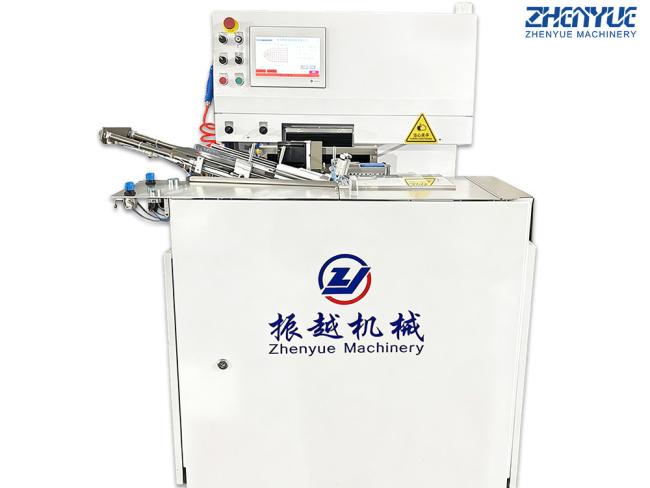
Higher speed must not cost retention force. The industry floor for tuft pull-out is 15N under ISO testing; aluminum-anchor machines measure 20-25N, brass-anchor designs around 35N. Speed does not change anchor retention, but faster machines demand better mechanicals: NSK or INA bearings, Panasonic or Tamagawa servos, and frames that hold hole-position accuracy at hour seven. The Zhenyue ZY-series runs 800-1000 cycles per minute on Fuji PLC and Delta servo control with ±0.1mm manipulator positioning — the component list that keeps a fast machine accurate all shift.
Before you trust any speed rating, ask for proof — the practical side of this how to read toothbrush tufting machine datasheet parameters guide:
✅ How many holes and colors was the rating measured with? Three-color changeover runs slower than single-color production.
✅ Ask for a continuous-run video or a customer reference at that exact speed — not a no-load test.
✅ Run a sample tufting test with your own handles and bristles, then measure pull-force yourself.
✅ Confirm whether the rating is per spindle or per machine, and the changeover time between brush models.
✅ Bottom line: Verify rated speed under your own product conditions — color count, hole diameter, and bristle type all move the real number.
Q: Is a 1000 holes/min toothbrush tufting machine always better than a 750 holes/min machine?
A: No. The same toothbrush tufting machine speed 420 vs 750 holes per minute compared logic applies at the top of the range: the fastest machine is rarely the right one. Above roughly 7,000 brushes per shift, a 750 machine covers most mid-scale demand, and end-rounding often caps the line below 1000 holes/min anyway. Buyers needing custom capacity planning can work with a China OEM manufacturer like Zhenyue to size a configuration to actual demand, not a catalog number.
Q: What does a toothbrush tufting machine speed of 850-900 holes per minute mean in daily output?
A: The toothbrush tufting machine throughput brushes per day calculation for this tier gives 7,600-7,800 brushes per 8-hour shift at 40 tufts per brush and 85% utilization — roughly 395,000 per month on two shifts. Priced at $24,000-30,000 in 2026, it is the sweet spot for serious-volume factories and the right benchmark before paying the 1000+ premium.
Q: Are there super high-speed toothbrush tufting machines above 1000 holes per minute?
A: A few. Chinese high-speed 2025 models and specialists like Boucherie's Hepta-FM (1200 tufts/min, wooden brushes) exceed the 1000 mark; European integrated lines such as ZAHORANSKY's Z.ORCA reach 3,600 brushes/hour across six colors. But 1000+ remains the practical ceiling for mainstream production; Zhenyue builds its ZY-series at 800-1000 cycles/min — fast enough for full-scale output, stable enough for daily use. The same how to read toothbrush tufting machine datasheet parameters guide discipline applies at every speed: ask what conditions the headline number assumes.
Send us your brush specification — tufts per brush, color count, hole diameter, and daily output target — and the Zhenyue engineering team will map it to the right ZY-series configuration and a balanced line layout, free of charge. We also run sample tufting tests with your own handles and bristles before you order.
Yangzhou Zhenyue Brush Machinery Co., Ltd., based in Hangji — the toothbrush capital of China — builds CE-certified tufting machines (certificate M.2025.206.C121543) and supports OEM/ODM customization for wholesale buyers worldwide. Contact our China factory for a quote, or ask about a sample test today.Email: lila@zybrushtech.com Mobile: +86 15262232790
Published: October 2026 | By Zhenyue Engineering Team
Email to this supplier

Privacy statement: Your privacy is very important to Us. Our company promises not to disclose your personal information to any external company with out your explicit permission.
Fill in more information so that we can get in touch with you faster
Privacy statement: Your privacy is very important to Us. Our company promises not to disclose your personal information to any external company with out your explicit permission.